

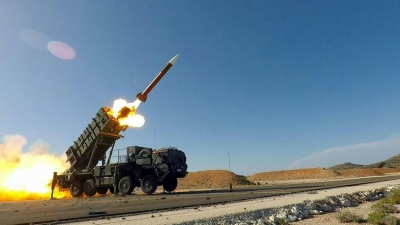
Footage of an Iranian missile attack on the US Al Udeid Air Base in Qatar has circulated widely across international media. The recordings appear to show that the American Patriot air defense system failed to intercept the incoming projectiles launched by the Islamic Republic. Analysts are now scrambling to interpret why this occurred and whether the Patriot missile system should now be considered technologically obsolete.
Targeting and failure
Retired Russian Colonel Mikhail Khodarenok notes that the first launch captured in the viral video proceeded as follows: the Patriot crew fired two missiles at the first target. Normal targeting orientation was observed, and the interceptors headed toward the projected target area.
While warhead detonations of both interceptors (likely MIM-104 variants) were recorded, there was no physical destruction of the enemy aerial threat.
Potential explanations
Several factors may explain this outcome. The warhead of a tactical-strategic ballistic missile possesses high structural integrity. To achieve destruction, anti-aircraft missiles require larger fragmentation elements (weighing tens of grams) compared to the smaller fragments (typically a few grams) used against aerodynamic targets. If the launched MIM-104 missiles were optimized for pilots and aircraft, they failed to destroy the target or even deflect it from its ballistic path.
Deviation or malfunction?
Against the second target, only one missile was launched. It passed near the target with a relatively small deviation, yet no warhead explosion or target destruction occurred.
The reasons remain unclear; there may have been a failure in the radio-proximity fuse or the safety mechanism, or perhaps the deviation was greater than anticipated. Further investigation and study of the debris are required.
Don’t write off the Patriot yet
However, it is incorrect to draw broad conclusions about low Patriot effectiveness based solely on these two launches. Once the conflict concludes and data regarding targets, hits, and failures are analyzed, it will be possible to accurately assess the system's performance.
Accusations against the Patriot surfaced as early as the 1991 Gulf War, but the reality was complex: while early versions had limited success against hardened ballistic warheads, modern PAC-3 systems are significantly more capable than their 1991 predecessors.
A powerful weapon
Lessons from previous Iranian missile attacks led to the development of the MIM-109 and ERINT missiles, the latter being a highly maneuverable interceptor designed for "hit-to-kill" impact. There are also criticisms regarding the use of the Patriot in the current Ukraine conflict, particularly against hypersonic missiles like the Kinzhal and Iskander-M, though full data remains unavailable due to wartime conditions. It must be emphasized that the Patriot remains a powerful weapon when operated by expert crews.
What happened
Video from the Al Udeid Air Base in Qatar showed three missiles launched from MIM-104 Patriot long-range systems failing to down incoming Iranian ballistic missiles. Iran launched these attacks on February 28, following the initiation of a coordinated large-scale military strike by Israel and the US.
While Patriot units typically fire two interceptors per target to ensure a high kill probability, a third launch may have been attempted to compensate for system reliability issues. This is a critical concern given the severely depleted missile stockpiles of the US Armed Forces, which were confirmed in July 2025 to have dropped to just 25% of the levels deemed necessary by the Pentagon.
Radar destruction
The failure of the Patriot systems closely coincides with confirmation that Iranian strikes destroyed vital air defense radars at the Al Udeid base. These radars may have been among several targets hit due to the limitations of American air defenses.
The Patriot system's reliability has long been questioned. Even limited Iranian attacks on June 23, 2025, proved capable of striking Al Udeid, despite the use of less advanced Fateh-313 missiles and the fact that the US had received prior warning. Although American officials initially praised the US Army and Qatari Air Force, released satellite imagery showing damage to the communications terminal forced Pentagon sources to admit the systems were not fully successful.
Harsh criticism
The Patriot's capabilities have sparked intense debate since the Gulf War, where systems were evaluated as nearly failing against basic Iranian Scud attacks. Later, they became a major cause of friendly fire during the US-led invasion of Iraq, erroneously targeting several American fighter jets.
Despite claims of success by US and Saudi sources regarding the interception of Yemeni ballistic missiles in late 2017, investigations proved they had failed completely. When deployed to protect Saudi oil fields, they were also entirely unsuccessful in stopping drone attacks launched by either Yemeni paramilitaries or Iran in 2019.
The example of the war in Ukraine
The Patriot's effectiveness against Russian missile attacks has been increasingly questioned in the Ukrainian theater. Both Ukrainian and Western sources have warned for months that its ability to intercept ballistic strikes is limited.
Ukrainian Air Force spokesperson Igor Ignat highlighted these system weaknesses on May 26, while the head of communications for the Ukrainian Air Command confirmed in early October that the service faces growing challenges in intercepting Russian ballistic missiles.
The largest US base in the Middle East
Constructed in 1996 with Qatari funding, Al Udeid serves as one of the largest US military bases outside the United States and the largest American air facility in the Middle East.
The base hosts the headquarters of US Central Command (CENTCOM) and the Combined Air Operations Center (CAOC), which controls coalition air operations from North Africa to Central Asia. Spanning 31 square kilometers, it is nearly double the size of Ramstein Air Base in Germany. At its peak, the facility has operated with 10,000 personnel, playing a pivotal role in operations over Syria and Afghanistan.
www.bankingnews.gr







Σχόλια αναγνωστών